
The closing is over, the keys are yours, and suddenly you’re juggling a dozen “new homeowner” tasks—utilities, mail, repairs, security, boxes everywhere. Insurance is usually the last thing people want to think about… until a leak, a theft, or a storm makes it urgent.
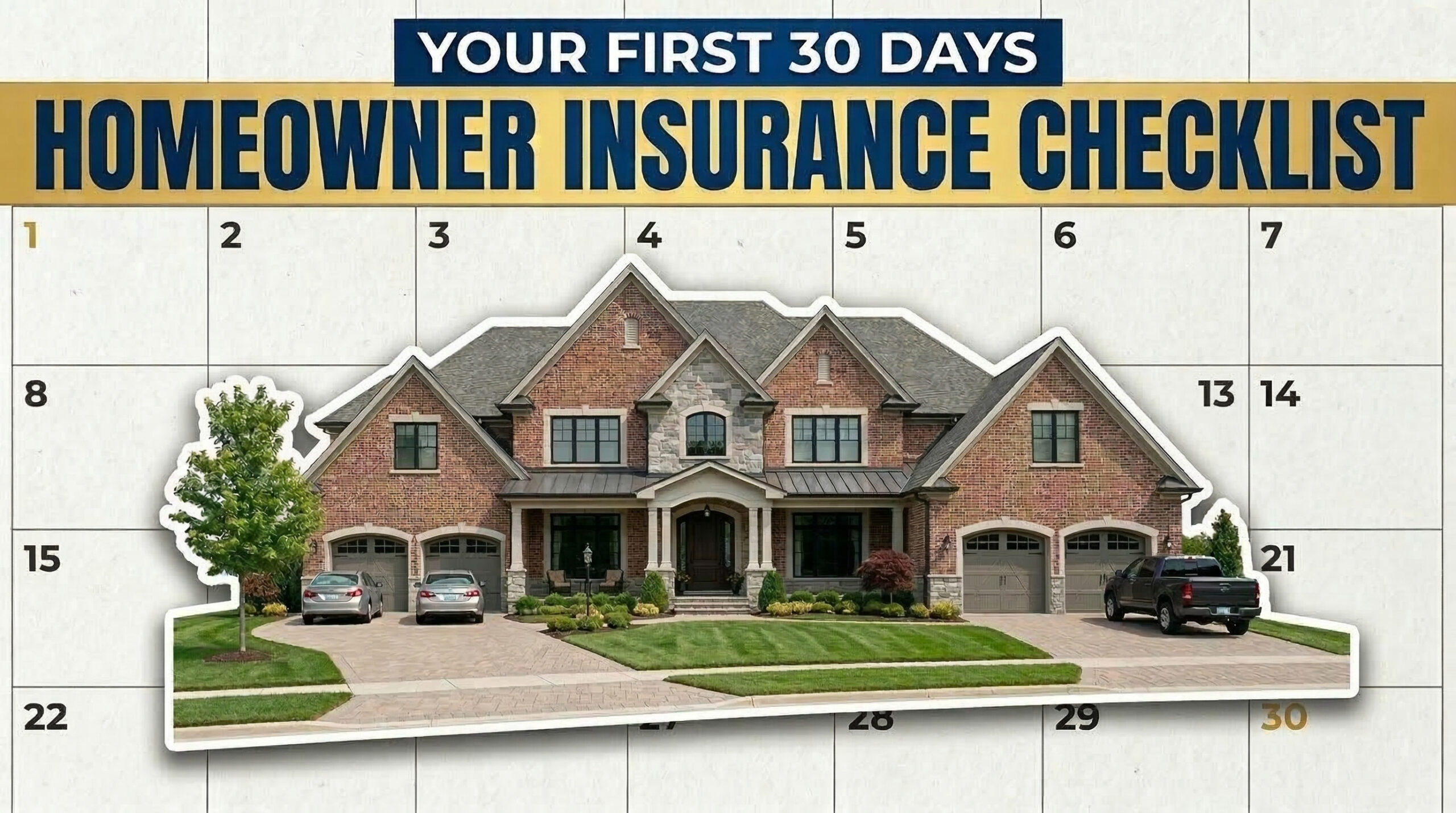
This first 30 days homeowners insurance checklist is designed for the moment you’re in right now: you moved in last week, you want to handle the admin correctly, and you don’t want to discover gaps when you need help. You don’t have to “optimize” anything today. You just need to (1) set up a clean home insurance file, (2) verify the basics, and (3) document what you own and what changed.
So here’s your first time homeowner insurance 30-Day Checklist…
The real reason the first 30 days matter (your policy was set up before you lived there)
Most homeowners policies are put in place during the closing process—when you’re still guessing how you’ll use the home day-to-day. Then real life happens quickly:
- You notice the kitchen sink drains slowly.
- A delivery shows up with a new appliance.
- You find the water shutoff is behind stacked boxes.
- You realize you don’t know where your policy documents are.
The point of the first month isn’t to become an insurance expert. It’s to close the gap between “policy created for closing” and “home you actually live in.” That gap is where confusion usually starts—especially if you’re trying to handle a claim later and you’re hunting through emails for a policy number, a declarations page, or proof of what you owned.
Day 1–3: Create your “Home Insurance Folder” (the 15-minute setup that saves hours later)
If you do only one thing this week, do this. A single folder system keeps you from losing time later when you’re stressed.
What to save in your Home Insurance Folder
Create one folder in cloud storage (and label it clearly). Then drop in:
- Declarations page (often called the “dec page”) or coverages summary
- Policy number and company contact info (even if you plan to call your agent first)
- Your agent’s name + phone + email
- Mortgage/lender/escrow details (closing disclosure or escrow notice)
- Any binder or proof-of-insurance documents you received at closing
- Basic property details you already have:
- closing date
- purchase documents
- inspection report (save it, but don’t rely on it as your only record)
Where to store it (so it’s actually usable)
- Cloud folder: easiest for receipts, photos, and “move-in documentation.”
- One printed page: print a single sheet with your policy number + agent contact and keep it somewhere you can find quickly (a kitchen drawer, a file box, or your home office).
This isn’t about paranoia. It’s about reducing friction when you need answers fast.
Day 1–7: Do a fast policy reality check (what to verify, not what to “change”)
This is a verification pass—not a redesign. Your goal is to confirm the policy matches the basic facts of your purchase and how it’s being paid.
Quick checks to make on the declarations page
Look for:
- Named insureds: your name (and any co-owner) spelled correctly
- Property address: correct and complete
- Effective date: lines up with when you became responsible for the home (often the closing date, but confirm)
- Mortgagee listed correctly: if you have a mortgage, your lender is usually listed as the mortgagee/loss payee
- Billing method: escrow vs direct-bill
- If escrow: confirm what’s being paid through escrow and what you’ll pay directly
- If direct-bill: confirm autopay method and the correct payment account
The point of this step
When something is wrong here (a name mismatch, address error, mortgagee missing, billing confusion), it doesn’t always show up until there’s a request for proof or a time-sensitive question. Fixing it later is usually more annoying than fixing it now.
Questions to write down for your agent (TBD list)
You’re not trying to decide coverage on your own. You’re building your “ask list.” Examples:
- “Can you confirm the mortgagee listing is correct?”
- “Is my billing set up as escrow or direct-bill?”
- “What documents should I keep if I make upgrades in the next few months?”
- “If I buy big items (appliances/tools), what proof is most helpful to store?”
If you capture the questions now, your future self will thank you.
Day 3–10: Build a basic home inventory—without making it a weekend project
A home inventory doesn’t need to be a spreadsheet marathon. “Good enough” beats perfect, especially when you’ve just moved.
The “good enough” inventory method (30 minutes)
Do three simple things:
- Walkthrough video: use your phone and do a slow walk through each room, opening closets and panning across major items.
- Room photos: take 4–6 photos per room (wide shots + one close-up of anything valuable).
- Major items list: create a quick note titled “Home Inventory — Move-In Month” and list major categories:
- electronics (TVs, laptops, cameras)
- appliances (washer/dryer, fridge if applicable)
- furniture sets
- tools/lawn equipment
- specialty items (bikes, musical instruments, collectibles)
You’re not proving everything today. You’re creating a baseline.
What receipts/proof to keep for new purchases and deliveries
In the first few weeks, you’ll buy items quickly—and receipts will disappear into email, delivery apps, and random paper.
Save what you can for higher-value items:
- Digital receipts or order confirmations
- Photos of the item + serial number/model number (electronics especially)
- Delivery confirmations
- Warranty registration pages/screenshots (optional, but useful)
- Before/after photos if an item replaces something broken (helps you remember what you upgraded)
Drop these into a subfolder inside your Home Insurance Folder called “Receipts + Proof (Year).” Don’t overthink it.
Day 7–14: Update your emergency contacts and shutoff knowledge (claim-prevention basics)
A lot of “insurance stress” isn’t actually about insurance. It’s about not knowing what to do in the first 10 minutes of a problem.
Find and label the key shutoffs
Take 15 minutes to locate and take photos of:
- Main water shutoff
- Electrical panel
- HVAC shutoff/switch (if applicable)
- Gas shutoff (if applicable; don’t touch it unless you know what you’re doing)
Save the photos in a folder called “Shutoffs + Systems.”
Build a simple emergency contact list
Create a note called “Home Emergency Contacts” and include:
- your agent’s number
- preferred plumber
- restoration/water mitigation company
- electrician
- HVAC company
- HOA/property manager contact (if applicable)
- local non-emergency line
Why this matters (without the scary part)
Knowing what to shut off and who to call can reduce how bad an issue becomes. And when an incident is smaller and cleaner, everything—from repairs to documentation—tends to be easier.
Day 10–21: Document the home’s condition and improvements you inherited
Here’s the misconception that trips up a lot of first-time homeowners:
“The inspection report is enough.”
It’s helpful, but it’s not a living record of your home’s condition after you move in—and it won’t capture everything you notice as you start living there.
What to document in the second and third week
Pick one afternoon and do a quick “condition snapshot.” You’re not creating a construction dossier. You’re saving evidence you can reference later.
- Roof condition (photos from ground level; note any visible issues)
- HVAC system (photo of model/serial plate; note service sticker if present)
- Water heater (photo of label + surrounding area)
- Plumbing under sinks (quick photo, especially if you notice moisture)
- Main exterior (front/back/sides)
- Any existing security system devices (cameras, sensors)
If you inherited improvements or recent updates
If the seller mentioned updates (roof, electrical, plumbing, remodel work), store any documentation you received:
- receipts
- warranties
- permits (if you have them)
- contractor names
If you didn’t receive documentation, don’t panic. Just note what you know and keep photos.
Why this helps in real life
Months later, when you’re trying to remember whether the water heater was already dented or whether that roof stain is new, these quick photos and notes give you clarity. They can also help you talk about the home accurately when you do a policy review after closing.
Day 14–30: Review your dwelling and deductible strategy with real-world context
This is the part people want to skip because it feels complicated. Keep it simple: you’re not trying to choose “the perfect policy.” You’re making sure your setup makes sense now that you’re in the house.
Start with the question that actually matters
If something happened tomorrow, could you comfortably handle your deductible without it becoming a crisis?
That question doesn’t pick your deductible for you—but it frames the decision around real life, not guesswork.
What to bring to your review conversation
Use what you collected earlier:
- your declarations page
- your “TBD questions” list
- your move-in inventory baseline
- any notes about improvements, upgrades, or new purchases
What this review is (and isn’t)
- Is: a sanity check that your policy aligns with the home and your situation
- Isn’t: a push to buy more coverage, add endorsements, or chase discounts
Coverage structure can affect premium and out-of-pocket reality. It’s okay to ask your agent to explain options in plain terms and compare like-for-like.
Common first-month mistakes that create claim headaches later
If you want to avoid the most common “why is this so hard?” moment later, avoid these:
- Misplacing the declarations page and policy number
- Not saving photos/video of your belongings early (especially after a big move-in purchase burst)
- Mortgagee/billing details left unverified (escrow confusion, wrong listing, missed communications)
- No system for receipts and proof (everything lives across email, texts, store apps, and paper)
- Assuming the inspection report is your documentation plan (it’s not designed for that)
- Making upgrades without keeping any record (even simple before/after photos help)
None of these are “fatal.” They just create delays and frustration when you’re already dealing with a stressful situation.
Low-friction next step: schedule a homeowners policy review (30-day check-in)
Moved in last week? Let’s do a quick 30-day insurance check-in so nothing gets missed.
Share your declarations page and any closing/escrow notes, and we’ll confirm the basics, answer your questions, and flag anything worth reviewing.
It’s a simple way to make sure your policy matches your home now—not just the paperwork from closing.
FAQ content
- What is the most important homeowners insurance task after move-in?
Set up a simple Home Insurance Folder and save your declarations page, policy number, agent contact info, and mortgage/escrow details. It’s the fastest way to prevent paperwork delays later. - When should I review my homeowners insurance after closing?
A practical window is within the first 30 days after move-in—once you’ve had a chance to notice the home’s systems, store your documents, and list any upgrades or major purchases. - How do I make a home inventory quickly for insurance?
Do a room-by-room phone video walkthrough, take a few wide photos per room, and write a short list of major items (electronics, appliances, tools, furniture). Save receipts and serial numbers for higher-value purchases. - What documents should I store for homeowners insurance?
At minimum: declarations page, policy number, agent contact info, billing/escrow notes, and photos/video of your belongings. Add receipts for major purchases and any improvement records you receive (warranties, invoices, permits). - Should I update my policy after buying new furniture or appliances?
You don’t always need an immediate change, but you should store proof of purchase and keep a record of major additions. If your buying activity is significant or you’re making upgrades, ask your agent what documentation they recommend and whether a review is appropriate. - What are common homeowners insurance mistakes in the first month?
Misplacing the policy documents, skipping a basic home inventory, not verifying mortgagee/billing details, failing to store receipts for big purchases, and relying on the inspection report as the only record of the home.
Schedule a 30-day homeowners policy review (quick check that your policy matches your home)
Moved in last week? Let’s do a quick 30-day insurance check-in so nothing gets missed.
Share your declarations page and any closing/escrow notes, and we’ll confirm the basics, answer your questions, and flag anything worth reviewing.
It’s a simple way to make sure your policy matches your home now—not just the paperwork from closing.
Request a homeowners quote comparison (same coverages, clearer options)
If you’re not sure your current setup is the best fit, we can compare options using the same coverage structure—so you’re not comparing apples to oranges.
RELATED LINKS: