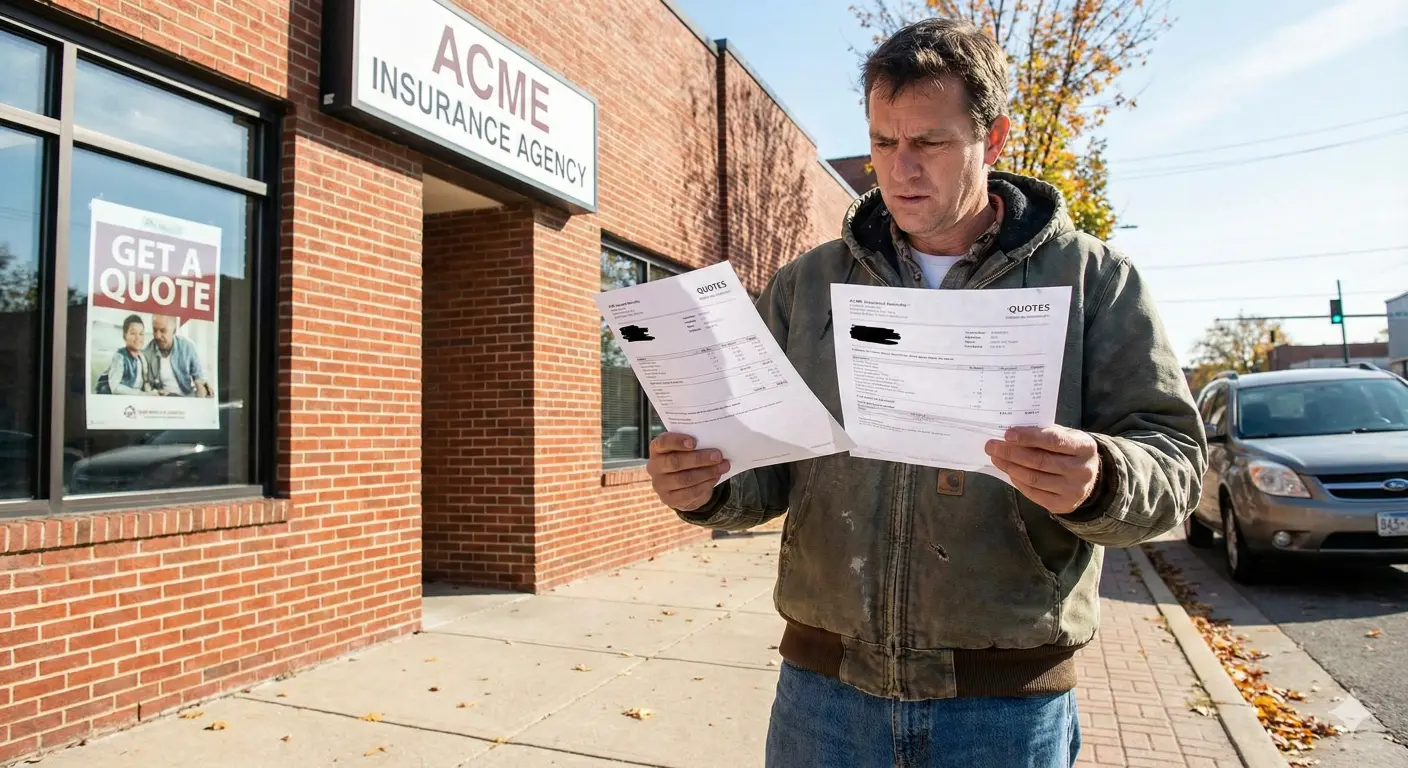
You’ve done the “hard part” already: filled out your info, answered the questions, and now you’re staring at a screen (or stack of emails) with multiple auto quotes.
One jumps out immediately—the lowest monthly premium.
In a world where auto insurance costs have jumped roughly 50% in five years according to federal data reported by major news outlets, shaving dollars off the bill is tempting. But claim costs have also climbed: the average auto liability claim for bodily injury is now in the mid–five figures, and even “normal” property damage claims run in the thousands once modern parts and labor are included.(III)
That’s why how you compare car insurance quotes matters as much as the quotes themselves.
This guide gives you a simple, spreadsheet-style method to compare quotes by coverage and value, not just price—so you don’t accidentally pick the cheapest policy that offers the worst protection.
The Problem With Staring Only at the Monthly Price
How marketing trains us to chase the lowest number
For years, most auto insurance ads have pushed one message:
“Switch and save X% on your car insurance.”
It’s natural to think that the “right” choice is the quote with the lowest monthly premium. But that number is only the output of dozens of hidden decisions:
- Liability limits
- Deductibles
- Optional coverages (rental, towing, uninsured motorist)
- How the quote tool interpreted your driving and vehicle history
If you compare price alone, you’re not really comparing policies—you’re comparing different sets of assumptions.
Why “savings” ads rarely talk about limits or exclusions
You almost never hear an ad say:
- “We reduced your bodily injury limit to save you money.”
- “We raised your collision deductible to cut your bill.”
- “We dropped rental reimbursement and uninsured motorist coverage to make the numbers look better.”
But those are exactly the kinds of levers that move your premium up or down. Industry and regulator reports show injury and damage claim severity (average cost per claim) rising notably over the last several years, especially as medical care and repair costs increased.(IA Magazine)
If your limits and coverages don’t keep up with real-world claim costs, the “savings” you see at quote time can disappear the moment something serious happens.
The risk of thinking all quotes are built on the same assumptions
Two quotes that look similar on the surface may differ in ways that matter a lot:
- One uses state minimum limits; another uses higher limits that better reflect injury and lawsuit risks.
- One sets $1,000 deductibles; another uses $500.
- One includes uninsured motorist and rental coverage; the other leaves them out.
Unless you line these up side by side, it’s easy to assume all quotes are roughly equivalent—and grab the lowest price without realizing what you gave up to get it.
The Three Numbers That Matter More Than the Premium
Before you decide which quote “wins,” focus on three areas that have an outsized impact on what happens in a claim.
1. Liability limits vs. real-world injury and damage costs
Liability coverage pays when you’re legally responsible for injuries or property damage to others. Many states still allow relatively low minimum liability limits, but:
- Average bodily injury liability claims are now around the mid–$20,000s per claim.
- Average property damage claims run into several thousand dollars each.(III)
Serious crashes, multiple injured people, or newer expensive vehicles can quickly push totals higher.
When comparing quotes, ask:
- Are all quotes using the same per-person / per-accident bodily injury limits?
- Are property damage limits high enough for the vehicles around you?
- How would each set of limits hold up if medical and legal costs grew beyond “average”?
If one quote is cheaper mainly because it’s using much lower liability limits, you’re not comparing apples-to-apples—you’re comparing more risk vs less risk.
2. Comprehensive and collision deductibles vs. your savings
Deductibles are what you pay out of pocket when your own car is damaged:
- Comprehensive: theft, fire, hail, falling objects, some animal strikes
- Collision: crashes with other vehicles or objects, regardless of fault
Higher deductibles typically reduce premiums, but claim costs for repairs have surged due to parts, labor, and vehicle technology.(IA Magazine)
When comparing quotes:
- Note the exact deductible amounts for comp and collision.
- Ask yourself: “If my car needed repairs tomorrow, could I comfortably pay this deductible without using debt or long-term savings?”
A quote that’s $10/month cheaper but carries a deductible you can’t realistically pay may not be a smart trade.
3. Uninsured/underinsured motorist limits in a world with many underinsured drivers
Uninsured/underinsured motorist (UM/UIM) coverage helps when:
- The other driver has no insurance, or
- They carry low limits that don’t fully cover your injuries or damage
Nationally, about one in seven drivers is uninsured, and many others carry only minimum limits.(III)
When comparing quotes, look for:
- Whether UM/UIM is included at all
- Whether UM/UIM limits match your liability limits (or are close)
- How different quotes treat this coverage in the price
A rock-bottom quote that excludes or drastically reduces UM/UIM coverage may leave you exposed in some of the most common “worst case” scenarios.
Building a Simple Quote Comparison Grid
Here’s where the spreadsheet mindset comes in.
Columns: carrier, premium, limits, deductibles, key extras
Instead of juggling quotes in your head, build a simple grid—on paper, in a spreadsheet, or using a downloadable template.
At minimum, create columns for:
- Carrier / Quote label
- Monthly & annual premium
- Bodily injury liability limits (per person / per accident)
- Property damage liability limit
- Uninsured/underinsured motorist limits
- Comprehensive deductible
- Collision deductible
- Key extras (checkmarks or notes):
- Rental reimbursement
- Towing/roadside assistance
- Gap coverage (if financed/leased)
- Other important add-ons
Then, fill in each row with the details from each quote.
You’ll often find that the “cheap one” stands out because something important is missing or reduced.
How to spot “too good to be true” outliers
As you populate your grid, watch for outliers:
- One premium is dramatically lower with:
- Much lower limits
- Much higher deductibles
- Missing UM/UIM and key extras
In that case, the quote isn’t “magic”—it’s just built on different assumptions. Rather than discarding it, treat it as a signal:
“Now I see what I’d have to give up for that price. Am I okay with that trade?”
Common misreads: confusing per-person vs per-accident limits
One of the easiest auto quote checklist mistakes is misreading liability limits:
- A split limit like 50/100/50 typically means:
- $50,000 bodily injury per person
- $100,000 bodily injury per accident total
- $50,000 property damage per accident
If another quote lists 25/50/25, the difference in protection is substantial—even if the price difference feels small.
When quotes use different formats or abbreviations, ask the agent or platform to spell them out in plain language so you can input them correctly into your grid.
📄 Secondary CTA: Download the Quote Comparison Grid
Turning this structure into a one-page worksheet or simple spreadsheet makes it much easier to line up quotes side by side and see where the real differences are.
POV — Why “Full Coverage” Is the Most Misleading Label in Your Stack
Breaking down what people think full coverage means
“Full coverage” isn’t a legal or technical term. Many people think it means:
- “Everything is covered in every situation.”
In reality, it usually means:
- Your policy includes liability, comprehensive, and collision
- You may or may not have strong limits, UM/UIM, rental, or other protections
Two quotes can both be described as “full coverage” and still be worlds apart in how they perform when it matters.
Why two “full coverage” quotes can be worlds apart
Example:
- Quote A: Higher liability limits, reasonable deductibles, strong UM/UIM, rental included
- Quote B: State minimum liability, high deductibles, no UM/UIM, no rental
Both may be called “full coverage” in casual conversation. But in a serious claim, Quote A is much more likely to protect your finances and keep your life moving, while Quote B may leave you paying large out-of-pocket costs.
Encouraging readers to ask for specifics, not labels
You’re allowed to ask any agent or platform:
- “What exactly do you mean by ‘full coverage’ in this quote?”
- “What are my liability limits, deductibles, and key extras?”
- “How would this policy handle a serious injury crash? A stolen car? An uninsured driver?”
If a quote can’t stand up to those questions, it’s not the right one—no matter how low the premium is.
Decision Point — Choosing Between Two Close But Not Identical Quotes
At some point, your grid will narrow down to two or three serious contenders. The prices may be close, but the details differ.
How to value better limits vs. $10–$20/month differences
When two quotes are within, say, $10–$20 per month of each other, ask:
- Which one gives higher liability limits that match real-world claim costs?
- Which one has deductibles I know I can pay if something happens tomorrow?
- Which one handles uninsured drivers and rental car needs better?
Given that serious claims can reach tens of thousands of dollars or more,(III) paying a bit more each month for significantly stronger protection can be a very rational choice.
When to pay more for stronger claim support and service
Coverage is one side; service is the other. When the price is close, consider:
- Does this carrier have a reputation for responsive claims handling?
- Do I have access to a local agent who will help me navigate a big claim?
- Is it easy to reach someone who knows my area and state laws?
Online reviews and independent surveys often highlight big differences in claims satisfaction between carriers—even when premiums are similar.(Stanton Insurance Agency, Inc.)
Questions to ask the agent behind each quote
Whether you’re talking to a local office or a call center, you can ask:
- “Can you walk me through how this policy would respond in three scenarios: serious injury crash, at-fault fender-bender, and uninsured driver?”
- “What changed to make this quote cheaper or more expensive than my current policy?”
- “If I wanted to match the limits and extras of Quote X from another company, what would this policy look like and cost?”
Their answers will tell you a lot about both coverage design and customer support style.
Using an Advisor as Your Quote Interpreter, Not Just Another Seller
Letting a local agent benchmark your stack of quotes
Instead of asking a local advisor to “beat” your cheapest quote on price alone, try this:
- Bring in your comparison grid or printed quotes.
- Say, “Here are the options I’m considering. Can you help me evaluate them and, if possible, build an apples-to-apples quote that fits or improves on the best one?”
A good agency—like Miles Jackson Insurance serving Georgia and Alabama as a GEICO exclusive local office—will:
- Point out where lower-priced quotes might be cutting into critical coverage
- Suggest realistic adjustments based on laws, risks, and claim trends in your area
- Build a proposal that respects both your budget and your risk tolerance
Red flags a professional sees that you might miss
Experienced advisors spot patterns quickly, such as:
- Liability limits far out of step with your income and assets
- Deductibles that don’t match what most households can handle
- Missing UM/UIM coverage in regions with high uninsured driver counts(III)
- Policies that don’t play well with your home or umbrella coverage
You still make the final call—but with more insight than you get from numbers on a screen.
How to keep the process transparent and in your control
Ask any advisor you work with to:
- Show you your options in writing
- Explain trade-offs clearly (“Here’s what you gain or lose if we change X”)
- Respect that you may choose to stay where you are
The right relationship feels like having a quote interpreter, not a high-pressure salesperson.
Transformation — From Overwhelmed Shopper to Confident Chooser
The relief of knowing why you picked a policy
When you use a comparison grid and ask the right questions, the decision becomes easier:
- You can articulate why you chose a certain policy
- You know which risks you’re accepting and which you’ve transferred to the insurer
- You’re less likely to experience “claim shock” if something serious happens
It’s not just “This was cheapest”—it’s “This was the best value for my household’s needs.”
Setting a reminder to repeat this process at renewal
Insurance isn’t “set it and forget it.” Premiums, laws, and your life all change. Set a reminder to:
- Pull your declarations page once a year
- Re-run a simpler version of your comparison process
- Adjust limits, deductibles, and extras as your finances and vehicles change
You don’t need to fully re-shop every year, but you do want to stay intentional.
Teaching your household this framework for other financial decisions
The same mindset—compare by structure and risk, not just price—applies to:
- Home and renters insurance
- Life and disability coverage
- Even things like phone plans and subscriptions
Once you’ve done it with auto quotes, you’ll have a reusable framework your whole household can benefit from.
Request an Apples-to-Apples Quote
If you’re holding several quotes and aren’t sure what you’d be giving up to choose the cheapest one, ask a local advisor to build an apples-to-apples quote. Bring your grid, your best offers, and your questions. The goal isn’t just to match a price—it’s to match or improve the coverage design behind it.
Important Reminder
All numeric examples in this article are illustrative only and based on broad industry benchmarks. Actual claim costs, premiums, and coverage options vary by state, insurer, vehicle, and driver profile. This article is general information, not legal or financial advice. Always review your specific situation and policy details with a licensed insurance professional in your state.