
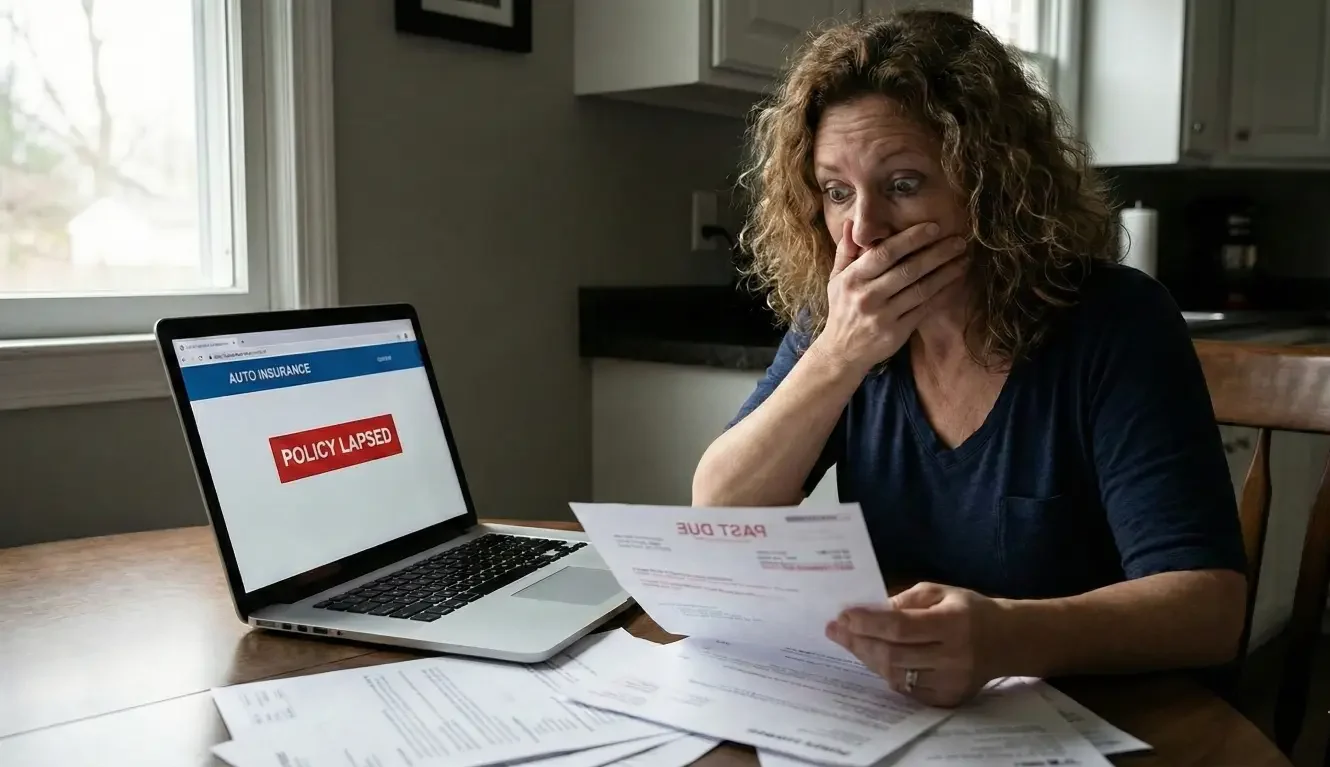
You missed a payment notice—or saw an email you meant to deal with—and now you’re wondering if your coverage is still active. In this moment, the biggest risk is doing the “obvious” thing fast and making the situation worse.
If you’re dealing with an auto insurance lapse in Georgia, this guide walks you through what to check first, what to do next, and the two mistakes that cause the most long-term headaches after an auto insurance lapse
The goal here is simple: confirm your status, fix what’s fixable, and keep a clean record of what happened—so you don’t end up with a bigger gap than you started with.
First, don’t guess—confirm whether you’re actually lapsed
When you get a missed-payment notice, the situation can feel binary: “I’m covered” or “I’m not.” But insurance portals and emails often use status language that’s easy to misread, especially when you’re scrolling fast.
Here are common labels you might see and what they can mean in plain English:
- Past due / payment due: You owe money. This does not always mean your policy has ended, but it does mean you’re on a clock.
- Pending cancellation / cancellation scheduled: The policy may still be active right now, but it’s headed toward cancellation if the payment issue isn’t resolved.
- Canceled / policy canceled: The policy is no longer active as of a stated date.
Those labels are helpful, but they’re not the full picture. Before you take any action, look for three things.
The three things to look for: status, effective dates, and cancellation notice language
- Current status on your account screen
Take a screenshot of the status page. If the language is unclear, a screenshot helps when you call or email for clarity. - Effective dates (especially a cancellation effective date)
If there’s a cancellation date listed, that date matters more than the general status label. It tells you when coverage ended (or would end). - Cancellation notice wording
If you received a formal notice (email, letter, PDF in your portal), read the part that shows the cancellation effective date and the reason (non-payment, billing issue, etc.). Don’t rely on the subject line alone.
If you only do one thing in the first two minutes: find the cancellation effective date (if it exists). That determines what “next step” is actually safe.
The quick timeline: how lapses usually happen (and where people misread it)
Most lapses follow a simple pattern, but the exact timing can vary by insurer and policy. That’s why it’s so important to follow what your notice says rather than what you assume “usually happens.”
A typical sequence looks like this:
- Missed payment notice
You’re told a payment is due, often with a due date. - A late or grace window (varies by policy)
This is the period where the policy might remain active while the payment issue is unresolved. The length and rules can vary. - Cancellation effective date
If the payment isn’t resolved, cancellation may become effective on a specific date.
Here’s where people get tripped up: they see “payment due,” pay quickly, and assume everything is instantly normal again.
Why timing matters: “I paid” vs “I’m reinstated” aren’t always the same moment
Paying a balance and being fully reinstated can feel like the same action, but they aren’t always the same outcome. You want to confirm not just that the payment went through, but that:
- the policy is active, and
- the effective date of coverage is what you think it is.
This is especially important if you’re trying to drive today, commute tomorrow, or show proof of insurance.
Mistake #1: Assuming a payment automatically restores coverage
This is the most common “panic move”: pay as fast as possible and move on. Paying is often the right step—but it’s incomplete if you don’t verify what the payment actually did.
What to verify after paying: confirmation details, reinstatement confirmation, effective date
After you pay, confirm three things:
- Payment confirmation details
Save the receipt screen or confirmation email. Make sure it includes the amount paid and the time/date. - Policy status changed to active (or similar)
Refresh the portal or app. If it still shows “canceled” or “pending cancellation,” don’t assume it will “catch up later.” - Effective date of coverage
Look for wording that indicates the policy is active as of a specific date/time. If you can’t find that, treat it as unknown until you confirm it.
If anything looks unclear, don’t guess. This is where a quick call or email is worth it.
What to do if the portal is unclear: who to contact and what to ask (script-style)
If your portal status doesn’t make sense—or if you paid but still see cancellation language—reach out and ask targeted questions.
Here’s a simple script you can use:
- “I received a missed-payment notice and I want to confirm whether my policy is active right now.”
- “If it was canceled, what is the cancellation effective date?”
- “I made a payment on [date/time]. Can you confirm whether the policy is reinstated?”
- “If it’s reinstated, what is the effective date and is there any gap in coverage?”
- “Can you send written confirmation of active coverage and the effective date?”
You’re not asking for a lecture. You’re asking for clarity you can document.
Mistake #2: Switching policies the wrong way and creating a bigger gap
When you get a missed-payment notice, it’s natural to think: “Fine, I’ll just switch companies.” Sometimes switching is a good long-term move. But switching in the middle of a payment problem is one of the easiest ways to create a bigger coverage gap.
The common move: cancel/replace too early or let old policy drop before new is active
Two patterns cause the most trouble:
- Letting the old policy cancel while shopping
You focus on getting quotes and forget the clock you’re already on. - Starting a new policy without confirming the old one’s status
You might assume the new policy “covers you now,” but the start date could be later than you think—or the policy could require additional steps to finalize.
Either way, you end up with uncertainty about whether you were covered on specific days. That uncertainty is what you’re trying to avoid.
How to avoid a coverage gap when switching (verification steps, not guarantees)
If you are switching carriers, keep it simple:
- Confirm the old policy’s status and cancellation effective date first.
- Choose a new policy start date that clearly overlaps or begins exactly when the old one ends (based on confirmed dates, not assumptions).
- Get written confirmation of the new policy’s effective date (and keep a copy).
- Don’t cancel anything manually unless you’re certain what you’re canceling and when it takes effect.
The safest switching decision is the one where you can point to documents that show continuous coverage dates.
What to do right now (in the safest order)
If you’re reading this because you just received a missed-payment notice, you don’t need theory. You need an order of operations that keeps you safe.
Step 1: Stop driving until status is confirmed (contextual caution)
If you genuinely don’t know whether your policy is active, treat that uncertainty seriously. The point isn’t to scare you—it’s to prevent a worst-case outcome while you’re sorting it out.
If you must make decisions quickly, prioritize confirming coverage status first.
Step 2: Check policy status + cancellation date
Log into your portal and find:
- current status (past due, pending cancellation, canceled),
- any cancellation effective date,
- any notice documents.
Screenshot what you see.
Step 3: Pay/resolve balance if available
If your portal allows payment and you plan to keep the policy, make the payment and save the confirmation.
If payment isn’t available or the portal shows the policy is already canceled, don’t keep clicking around—move to Step 4.
Step 4: Get written confirmation of reinstatement/effective date (or new policy start date)
This is the step most people skip, and it’s the step that makes everything cleaner.
You want one of these in writing:
- “Your policy is active effective [date],” or
- “Your policy was canceled effective [date],” or
- “Your new policy is effective [date].”
If the effective date is unclear, keep asking until it’s clear.
Step 5: Save proof (screenshots/email/ID cards)
Create a small “proof folder” on your phone:
- payment confirmation
- updated insurance ID cards (if available)
- confirmation email or declarations page showing active dates
- screenshots of portal status
If you ever need to show proof quickly, you’ll be glad you kept it organized.
If reinstatement isn’t available (or you’re told it’s canceled), here’s your clean reset plan
Sometimes you’ll be told the policy can’t be reinstated—or the cancellation is already final. If that happens, the goal becomes a clean restart without making the gap worse.
What info you’ll need to start a new policy
Have this ready so you can move fast without mistakes:
- Driver information (names, license details if requested)
- Vehicle information (VIN, mileage estimate)
- Garaging address
- Usage details (commute/pleasure/business)
- Any current documentation you have (even a canceled declarations page can help clarify prior coverage)
If there’s a teen driver in the household, include them accurately. Leaving a driver off may look like a “cheaper quote,” but it can create serious problems later.
How to choose a start date that avoids gaps (verification-first wording)
Choose a start date based on confirmed information:
- If you know exactly when the prior policy ended, you can plan the new policy to begin immediately after.
- If you don’t know, confirm the cancellation effective date first before selecting a start date.
Once you have the new policy, get written confirmation of the effective date and save it with your proof folder.
Preventing a repeat lapse: small payment-plan habits that actually stick
The fastest way to make a lapse “expensive” is to let it happen twice. Not because you’re irresponsible—because life gets busy and billing issues tend to repeat unless you set up a system.
Here are practical habits that reduce repeat lapses.
Autopay + backup payment method
Autopay helps, but it’s not magic. Autopay fails when:
- a card expires,
- a bank account is short,
- a fraud alert blocks a charge.
If your insurer allows it, set a backup method or at least create a monthly check-in to confirm autopay is still active.
Calendar reminders for renewal/payment dates
Set two reminders:
- one a week before the due date,
- one two days before the due date.
This matters even if you use autopay. The reminder is a safety net for autopay failures.
A “policy check” routine after any change (address, vehicle, drivers)
Changes can trigger billing issues or policy updates:
- moving addresses,
- adding a vehicle,
- adding a teen driver,
- changing coverage.
When you make a change, do a quick follow-up check:
- confirm the change is reflected correctly,
- confirm billing is still set up as expected,
- save updated documents.
It’s a two-minute routine that prevents a lot of “how did this happen?” moments.
How to verify you’re covered
Once you’ve paid, reinstated, or started a new policy, the final step is proving it to yourself—clearly.
Where proof typically shows up: ID cards, declarations page, confirmation email (general)
Look for:
- Updated insurance ID cards showing active dates (if dates are displayed)
- Declarations page showing policy period and coverages
- Confirmation email or letter stating the policy is active and effective as of a date
If you don’t see updated documents, don’t assume they’ll appear later. Request them.
What evidence to keep and for how long (TBD; suggest “keep it accessible”)
Rather than guessing timeframes, keep it simple: keep your proof accessible—especially around the period where the lapse occurred. Save digital copies so you can pull them up quickly if needed.
Get help confirming status and rebuilding coverage
If you just received a missed-payment notice, the safest move is to confirm your status before you assume you’re covered.
Send a screenshot of your policy status or the notice you received, and we’ll help you map the timeline and next steps.
If you need to reinstate or restart coverage, we’ll help you do it in a way that avoids unnecessary gaps.
Call or request help from our Newnan team.
FAQ content
1) What happens if my car insurance lapses in Georgia?
Rules and consequences can vary and can be serious. The most important first step is to confirm whether you’re truly lapsed and the cancellation effective date shown on your notice or portal. If you’re unsure, confirm your policy status before driving and get written confirmation of active coverage or the date coverage ended.
2) How do I reinstate car insurance after a missed payment?
Start by checking your policy status and the cancellation effective date. If payment is available, pay the balance and save the confirmation. Then verify the policy is active and confirm the effective date of coverage in writing. If reinstatement isn’t available, you may need to restart coverage with a new policy.
3) Does paying late automatically restore coverage?
Not always. Payment may resolve the balance, but you should still confirm the policy is active and the effective date. If the portal is unclear, contact support or your agent and request written confirmation.
4) How do I avoid a lapse when switching car insurance companies?
Confirm your current policy’s status and cancellation effective date first. Then start the new policy with an effective date that avoids a gap, and get that effective date in writing. Don’t assume the policies overlap unless your documents clearly show they do.
5) Can I drive if I’m not sure whether my policy is active?
If you truly don’t know whether you’re covered, the safest step is to confirm status first. Check your portal for current status and any cancellation effective date, then get written confirmation of active coverage before you rely on it.
6) Does an insurance lapse affect future premiums?
A gap can be viewed as higher risk by some insurers, so it’s worth fixing quickly and preventing repeats. Even if you restart coverage cleanly, keeping documentation of dates and taking steps to avoid another lapse can help you stay in control going forward.
Send your missed-payment notice (or screenshot of policy status) and we’ll help you confirm what’s active and what to do next.
Request a Newnan, GA auto quote to restart coverage cleanly.
If you just received a missed-payment notice, the safest move is to confirm your status before you assume you’re covered.
Send a screenshot of your policy status or the notice you received, and we’ll help you map the timeline and next steps.
If you need to reinstate or restart coverage, we’ll help you do it in a way that avoids unnecessary gaps.
Call or request help from our Newnan team.